Crossroads of Becoming
This collection explores identity as a process rather than a fixed state. Through collage, fragmented bodies, mythology, fashion imagery, and symbolic landscapes, the works investigate how gender, belonging, sexuality, and selfhood are produced through cultural systems, social expectations, and relationships of power.
Across the collection, bodies are divided and reconstructed, occupying spaces of transition rather than certainty. Mythological references and symbolic imagery function as visual languages through which questions of femininity, observation, desire, land, and place emerge. Rather than presenting identity as singular or stable, these works suggest that the self is continually formed through memory, embodiment, regulation, and resistance.
The collection examines the spaces between categories: between visibility and concealment, autonomy and regulation, selfhood and performance, belonging and exclusion. Existing within these thresholds becomes not merely a condition of fragmentation, but a possibility for transformation.
Ἑκάτη
R. Allen Smith
Paper collage using printed and cut Unsplash images
2025
Concept:
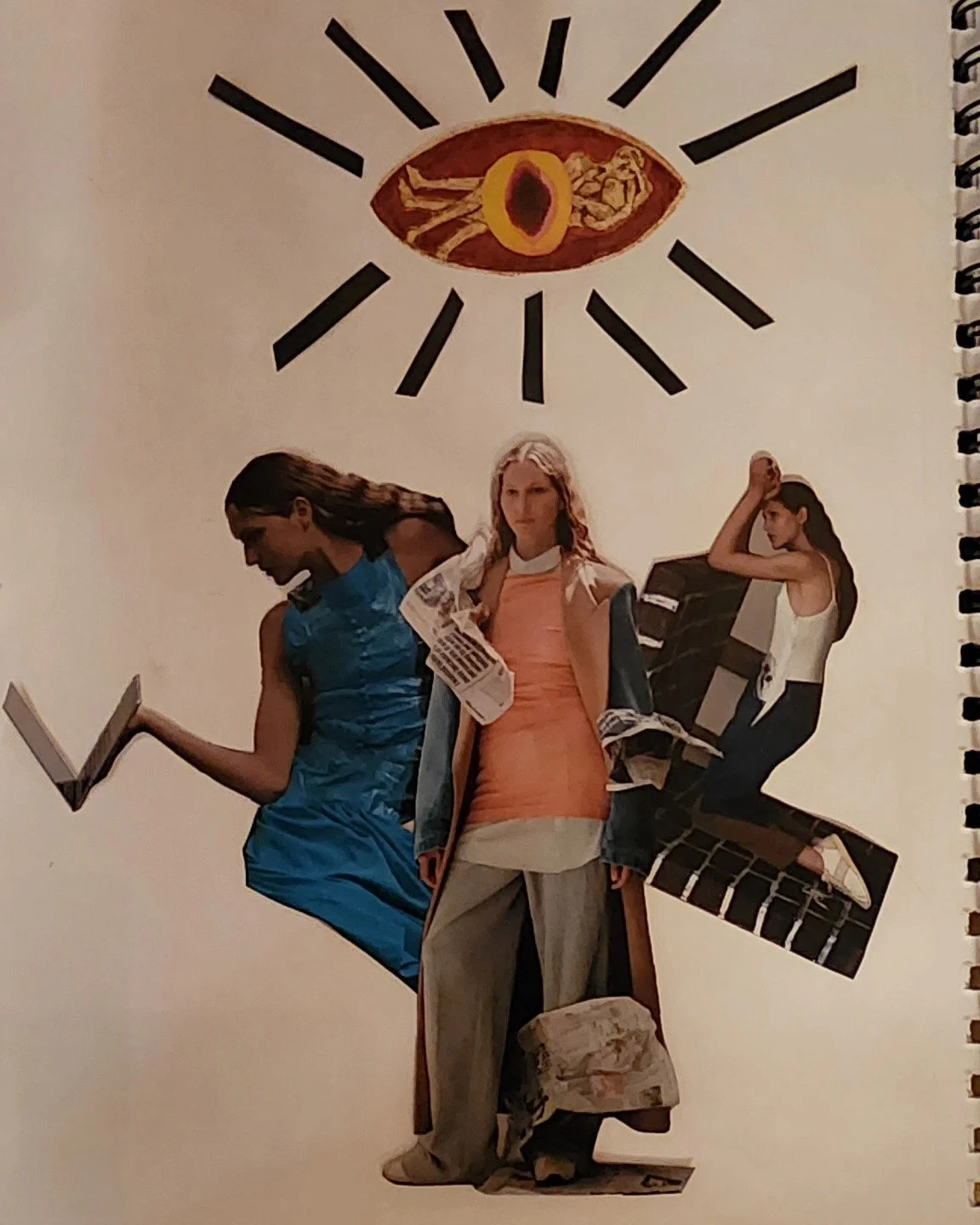
Hecate is associated with crossroads, thresholds, liminality, and hidden knowledge. Rather than treating her simply as a goddess of darkness or magic, this work draws on her role as a figure of transition, a presence at unstable boundaries where movement, danger, protection, and transformation meet (Johnston, 1991). The three female figures evoke Hecate’s triple form, recalling ancient descriptions of her as a figure attached to multiplicity, direction, and threshold space (Pausanias, trans. 1918).
This collage situates femininity within a space of observation and becoming. The women occupy different positions beneath a symbolic eye, suggesting the pressures of visibility, identity construction, and social expectation. Constructed from intertwined bodies and centered around an exposed peach pit, the eye transforms from a symbol of surveillance into one of desire, creation, and embodied knowledge.
Interpretive statement:
Ἑκάτη explores the experience of existing at intersections: between self and performance, visibility and desire, autonomy and expectation. The central eye functions simultaneously as witness, regulator, and creator. It recalls systems of visibility that discipline bodies by making them available to observation (Foucault, 1995), while also engaging feminist critiques of how femininity is often arranged as an object of looking (Mulvey, 1975).
Yet the eye in this work is not only a mechanism of surveillance. It also becomes a site of embodied knowledge. The exposed peach pit suggests interiority, sexuality, fertility, and the hidden core of self. Through this image, the collage reframes the body as a source of meaning rather than merely an object to be interpreted from the outside. This shift echoes Haraway’s argument that vision is never neutral or disembodied; knowledge is always situated, partial, and connected to the body that sees (Haraway, 1988).
Rather than presenting womanhood as singular, stable, or complete, Ἑκάτη fragments femininity into multiple presences and possibilities. The three figures suggest phases of identity, competing selves, and threshold states. In this sense, the work also resonates with Butler’s theory of gender as something repeatedly produced through performance, recognition, and social repetition (Butler, 1990). Through mythology and bodily symbolism, femininity becomes a threshold space where identities are continually produced, watched, interrupted, and transformed.
Imagery:
Eye = consciousness, revelation, hidden knowledge, surveillance, and the gaze
Intertwined bodies = desire, intimacy, sexuality, and embodied experience
Exposed peach pit = femininity, sexuality, fertility, hidden interiority, and the core of self
Three female figures = multiplicity, phases of identity, directional possibility, and Hecate’s triple form
Fragmentation = unstable identity, shifting selfhood, and transformation
Fashion imagery = constructed selfhood, social performance, and legibility
Threshold composition = crossroads, liminality, becoming, and transition
Theoretical note:
The gaze produces subjects. In Ἑκάτη, the eye functions as both observer and maker, suggesting that identities are created as much as they are seen. Foucault’s account of disciplinary visibility helps frame the eye as a structure of regulation: power works by making bodies visible, knowable, and self-monitoring (Foucault, 1995). Mulvey’s theory of visual pleasure further clarifies how femininity is often positioned within systems of looking, display, and objectification (Mulvey, 1975).
However, the collage does not leave the feminine body trapped within the gaze. By building the eye from intertwined bodies and centering it around the peach pit, the work turns looking into a threshold experience. Vision becomes embodied, erotic, partial, and generative. Hecate’s mythology deepens this movement: she is not only a figure at the crossroads, but a guide through uncertain passages. Here, femininity is not a fixed identity; it is passage, multiplicity, and transformation.
References:
Butler, J. (1990). Gender trouble: Feminism and the subversion of identity. Routledge.
Foucault, M. (1995). Discipline and punish: The birth of the prison (A. Sheridan, Trans.). Vintage Books. Original work published 1975.
Haraway, D. (1988). Situated knowledges: The science question in feminism and the privilege of partial perspective. Feminist Studies, 14(3), 575–599. https://doi.org/10.2307/3178066
Johnston, S. I. (1991). Crossroads. Zeitschrift für Papyrologie und Epigraphik, 88, 217–224.
Mulvey, L. (1975). Visual pleasure and narrative cinema. Screen, 16(3), 6–18. https://doi.org/10.1093/screen/16.3.6
Pausanias. (1918). Description of Greece, Volume I: Books 1–2 (W. H. S. Jones, Trans.). Harvard University Press. Original work published ca. 2nd century C.E.
No Land
R. Allen Smith
Paper collage using printed and cut Unsplash images
2025
Concept:
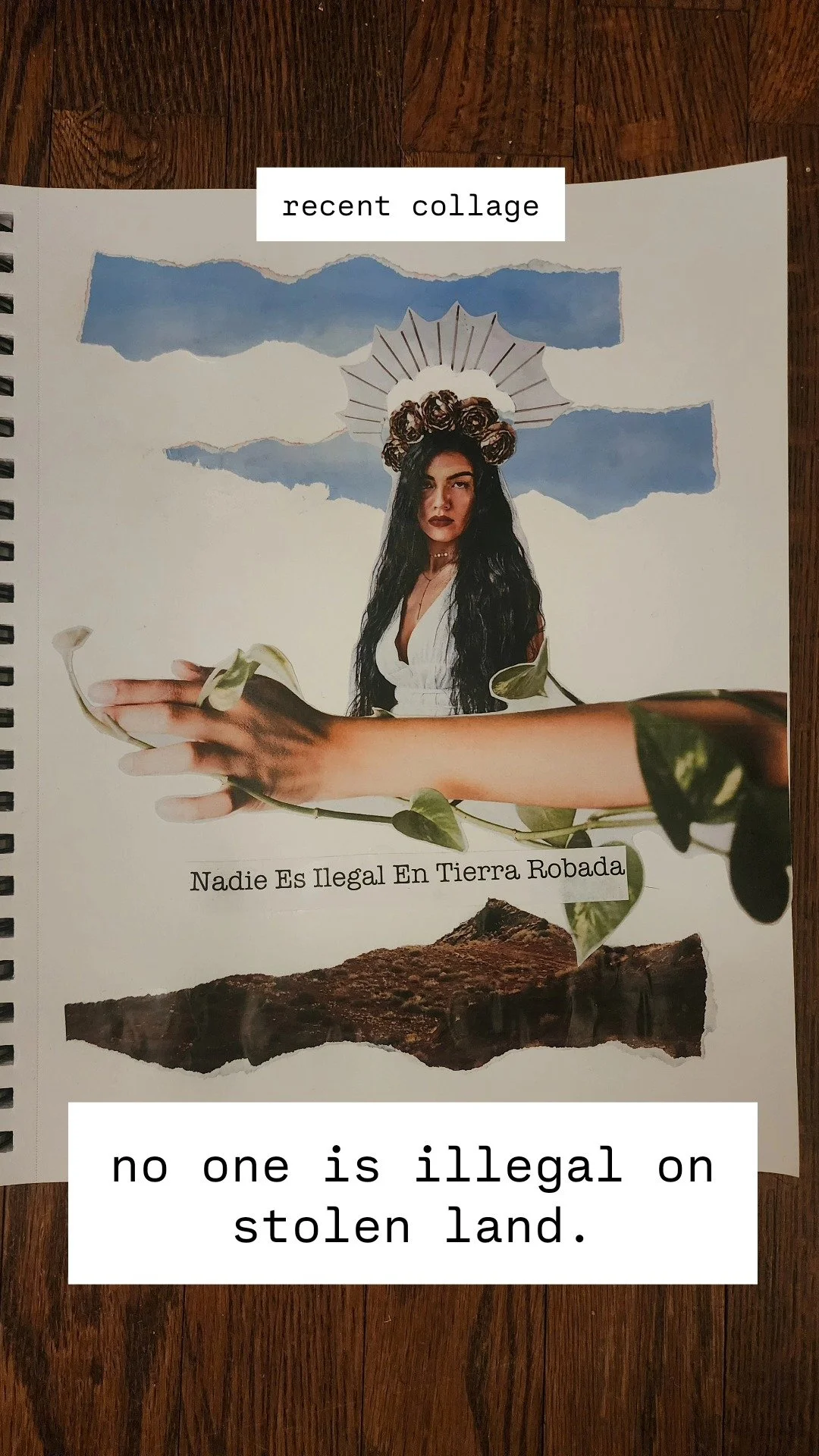
No Land connects identity to histories of colonization, belonging, migration, and territorial power. Sacred imagery is reimagined through anti-colonial language, positioning the figure between goddess, witness, and agent of resistance. The Spanish phrase “Nadie es ilegal en tierra robada” challenges the authority of borders by placing migration within the longer history of settler colonialism, land dispossession, and state-produced categories of legality (De Genova, 2002; Tuck & Yang, 2012; Wolfe, 2006).
Interpretive statement:
No Land reconsiders ideas of ownership, nationhood, and belonging. The central figure occupies a space between human and icon, appearing as both sacred witness and political refusal. The crown or halo suggests sanctification and authority, but that authority is redirected away from the nation-state, property, and colonial possession. Instead, the work uses sacred visual language to question who has historically been granted the power to define land, borders, legitimacy, and place.
The Spanish declaration “Nadie es ilegal en tierra robada” refuses the neutrality of borders. Its language matters. Spanish places the work in conversation with migration, borderlands, colonial history, and the racialized politics of legality. The phrase suggests that “illegality” is not an inherent human condition but a category produced through law, surveillance, and the state (De Genova, 2002). At the same time, the phrase situates migration within settler colonial histories, where land is claimed, renamed, bordered, and governed through systems that erase or diminish Indigenous sovereignty (Tuck & Yang, 2012; Wolfe, 2006).
The figure’s extended hand introduces a counter-gesture: invitation, care, reclamation, or refusal. Rather than presenting land as property, No Land imagines land as relation, memory, responsibility, and contested history. The work asks what it means to belong without possession, and what forms of justice become visible when borders are understood not as natural truths but as historical constructions.
Symbols:
Crown/halo = sanctification, authority, sacred witness, and redirected power
Vines = continuity, relation, life, survival, and connection to land
Landscape = territory, memory, colonial history, and contested belonging
Extended hand = invitation, care, reclamation, refusal, or offering
Sacred/iconic figure = moral authority, witness, protection, and resistance
“Nadie es ilegal en tierra robada” = anti-colonial critique of borders, citizenship, migration, property, and state legitimacy
Spanish language = borderlands, colonial history, migration, racialized legality, and refusal
Natural forms = land as relation rather than possession
Theoretical note:
This piece understands land as historical, political, and relational rather than neutral territory. Lefebvre’s theory of the production of space helps frame land as something shaped through social relations, institutions, and power rather than as an empty surface awaiting ownership (Lefebvre, 1991). Wolfe’s theory of settler colonialism sharpens this reading by emphasizing that settler colonial power is organized around land possession and the ongoing replacement of Indigenous relations to place (Wolfe, 2006). Tuck and Yang further clarify that decolonization cannot be treated as a loose metaphor; it is materially tied to Indigenous land and life (Tuck & Yang, 2012).
The Spanish phrase also opens the work toward borderlands theory. Anzaldúa’s writing on the U.S.–Mexico borderlands frames the border not only as a geographic line, but as a psychic, cultural, linguistic, and political wound (Anzaldúa, 1987). In No Land, Spanish becomes more than translation. It becomes a marker of contested belonging and a refusal of the state’s power to decide who is legitimate, who is foreign, and who is allowed to remain.
The work also challenges the category of the “illegal” person. De Genova’s analysis of migrant illegality shows that illegality is produced through law, policy, surveillance, and deportability rather than through any natural quality of the migrant body (De Genova, 2002). In No Land, sacred imagery interrupts that legal and colonial logic. The haloed figure does not authorize borders; instead, the figure exposes their violence. The work shifts authority away from the state and toward land, memory, relation, and collective belonging.
Morgan’s theory of religious visual culture helps clarify the crown or halo. Sacred images do not merely decorate belief; they organize ways of seeing, feeling, and assigning meaning (Morgan, 2005). Here, sacred visual language is turned toward anti-colonial critique. The figure becomes not simply holy, but ethically charged: a witness to stolen land, bordered bodies, and the possibility of belonging otherwise.
References:
Anzaldúa, G. (1987). Borderlands/La Frontera: The new mestiza. Aunt Lute Books.
De Genova, N. P. (2002). Migrant “illegality” and deportability in everyday life. Annual Review of Anthropology, 31, 419–447. https://doi.org/10.1146/annurev.anthro.31.040402.085432
Lefebvre, H. (1991). The production of space (D. Nicholson-Smith, Trans.). Blackwell. Original work published 1974.
Morgan, D. (2005). The sacred gaze: Religious visual culture in theory and practice. University of California Press.
Tuck, E., & Yang, K. W. (2012). Decolonization is not a metaphor. Decolonization: Indigeneity, Education & Society, 1(1), 1–40.
Wolfe, P. (2006). Settler colonialism and the elimination of the native. Journal of Genocide Research, 8(4), 387–409. https://doi.org/10.1080/14623520601056240
A ‘Good’ Girl
R. Allen Smith
Paper collage using cut imagery from popular magazines
2025
Concept:
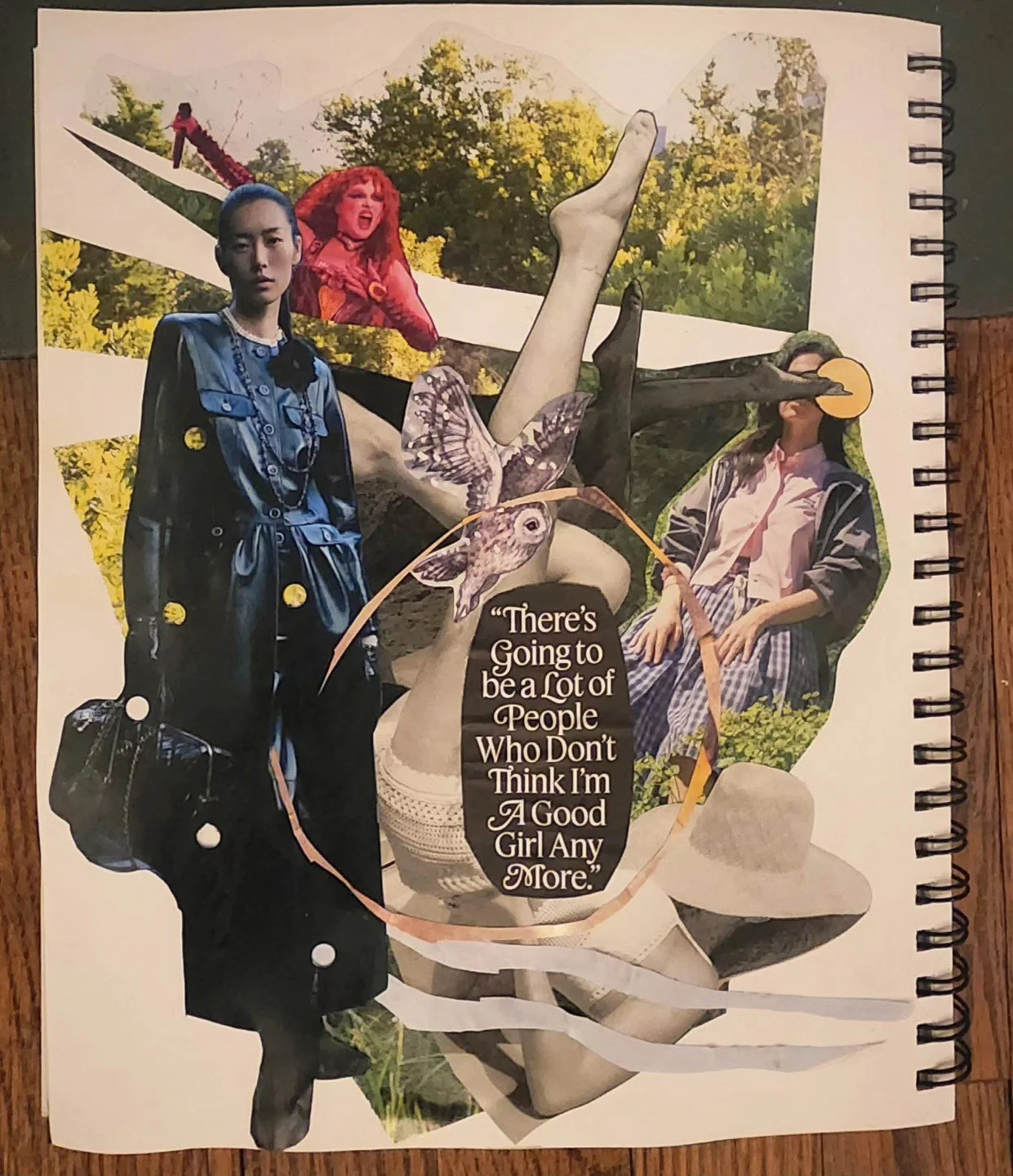
This piece examines the disciplinary expectations surrounding femininity, respectability, and social approval. The phrase “good girl” becomes unstable: part label, part accusation, part command, and part refusal. Through fragmented bodies, obscured faces, fashion imagery, and natural symbols, the work suggests an identity being assembled under pressure while resisting the demand to remain legible, obedient, or approved.
Interpretive statement:
A ‘Good’ Girl explores the social scripts attached to femininity and respectability. Bodies are fragmented and repositioned within an unstable landscape, suggesting identities assembled from cultural expectations, memory, desire, and resistance. The central text confronts the cost of departing from socially approved womanhood, while the surrounding imagery refuses wholeness as a requirement for legitimacy. The work asks who gets to define “good,” what forms of discipline hide inside that word, and what becomes possible when the category begins to break apart.
Symbols:
Owl = knowledge, intuition, hidden sight
Detached limbs = fragmentation and reconstruction
Landscape = cultural terrain and inherited expectations
Obscured face = surveillance, silencing, or refusal of legibility
“Good girl” text = disciplinary language and gendered control
Fashion figure = performed respectability and social legitimacy
Circular line = containment, repetition, or the loop of expectation
Theoretical note:
Drawing on Judith Butler’s understanding of identity as repeatedly performed and contested, A ‘Good’ Girl wrestles with becoming rather than arrival (Butler, 1990). Femininity appears not as a fixed truth but as something produced through repeated gestures, judgments, corrections, and expectations. The piece also echoes Michel Foucault’s account of discipline: the “good girl” is shaped through social surveillance and normalized behavior (Foucault, 1995).
References
Butler, J. (1990). Gender trouble: Feminism and the subversion of identity. Routledge.
Foucault, M. (1995). Discipline and punish: The birth of the prison (A. Sheridan, Trans.). Vintage Books. Original work published 1975.