Artistic Overture
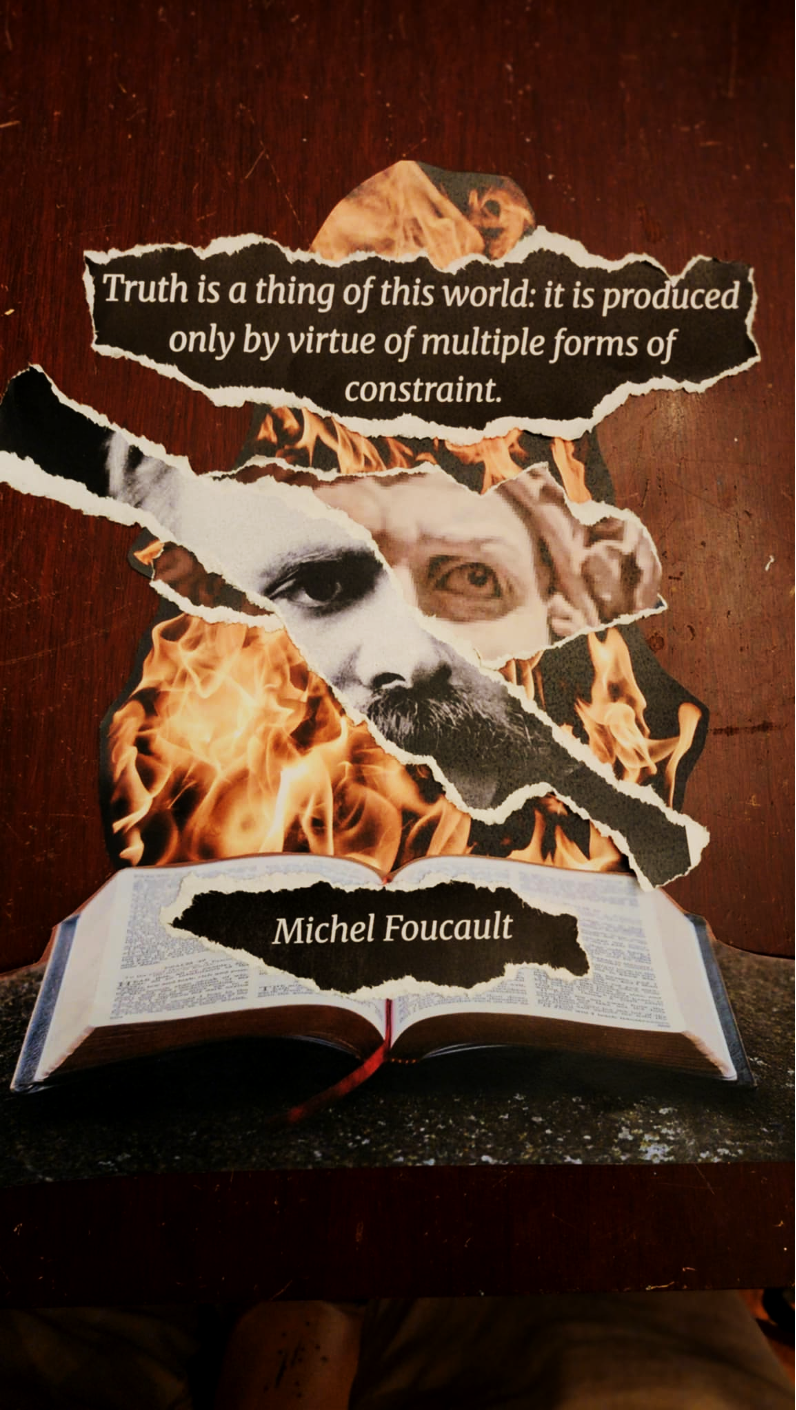
R. Allen Smith, Artistic Overture, 2024
Paper collage with cut imagery from Unsplash and public-domain photographs
Photographed assemblage; unfixed
This collage appears as the artistic overture to my 2025 dissertation, Liturgy: A Foucauldian Genealogy on the Discourse of Moral Ideologies Within Educational Assessment. I include it here as a piece of work that performs what I believe collage can do: stage a philosophical argument visually, hold it open rather than resolve it, and invite the viewer into a method of inquiry rather than a conclusion.
Collage transforms static images into a new assemblage of ideas, symbols, and tensions. I am drawn to the form because it allows the past to be reassembled into a present that differs from what it once was. In this work, images, ideas, and wonder move across one another without fixed boundaries. The collage engages the philosophical anchors and literary muses that shape my research, especially questions of truth, morality, punishment, genealogy, and critique.
This work serves as an overture to you, dear reader.
My collage features Dante’s eyes, symbolizing the academic gaze, literary imagination, and critique. Nietzsche’s partial face extends as a metaphorical root toward Foucault’s genealogical method. A fire blazes in the background, symbolizing punishment and divine judgment, while a holy book rests on a rock, representing moral truths often treated as neutral or self-evident. These images are interrupted by Foucault’s quote and name, creating a heretical poststructural disruption. The work visually unsettles the idea that truth exists outside power, echoing Foucault’s claim that truth is produced through constraint, discourse, and social relations (Foucault, 1980).
In creating this piece, I intentionally did not paste the collage together. I left it mutable and then photographed it. The photograph therefore does not simply document a finished object; it preserves a temporary arrangement, a moment of contact between fragments before they could become fixed. This choice mirrors the dissertation’s method: genealogy does not search for a pure origin, but traces shifting formations, ruptures, and conditions of possibility.
As I creatively share my research, experiences, and critiques of education, I hope this artistic moment invites others to begin their own work with a rebellious and transformative sense of wonder.
Text adapted from Smith (2025), pp. 138–139, and revised for web publication.
Image Sources
Dante statue: Photo by Edo on Unsplash.
Fire: Photo by Tobias Rademacher on Unsplash.
Bible: Photo by Aaron Burden on Unsplash.
Nietzsche: Portrait of Friedrich Nietzsche by Gustav Schultze, 1882. Public domain, via Wikimedia Commons.
References
Foucault, M. (1980). Truth and power. In C. Gordon (Ed.), Power/knowledge: Selected interviews and other writings, 1972–1977 (C. Gordon, L. Marshall, J. Mepham, & K. Soper, Trans., pp. 109–133). Pantheon Books.
Smith, R. A. (2025). Liturgy: A Foucauldian genealogy on the discourse of moral ideologies within educational assessment [Doctoral dissertation, Appalachian State University]. Appalachian State University Figshare Repository. https://doi.org/10.71889/5fylantbak.29613587