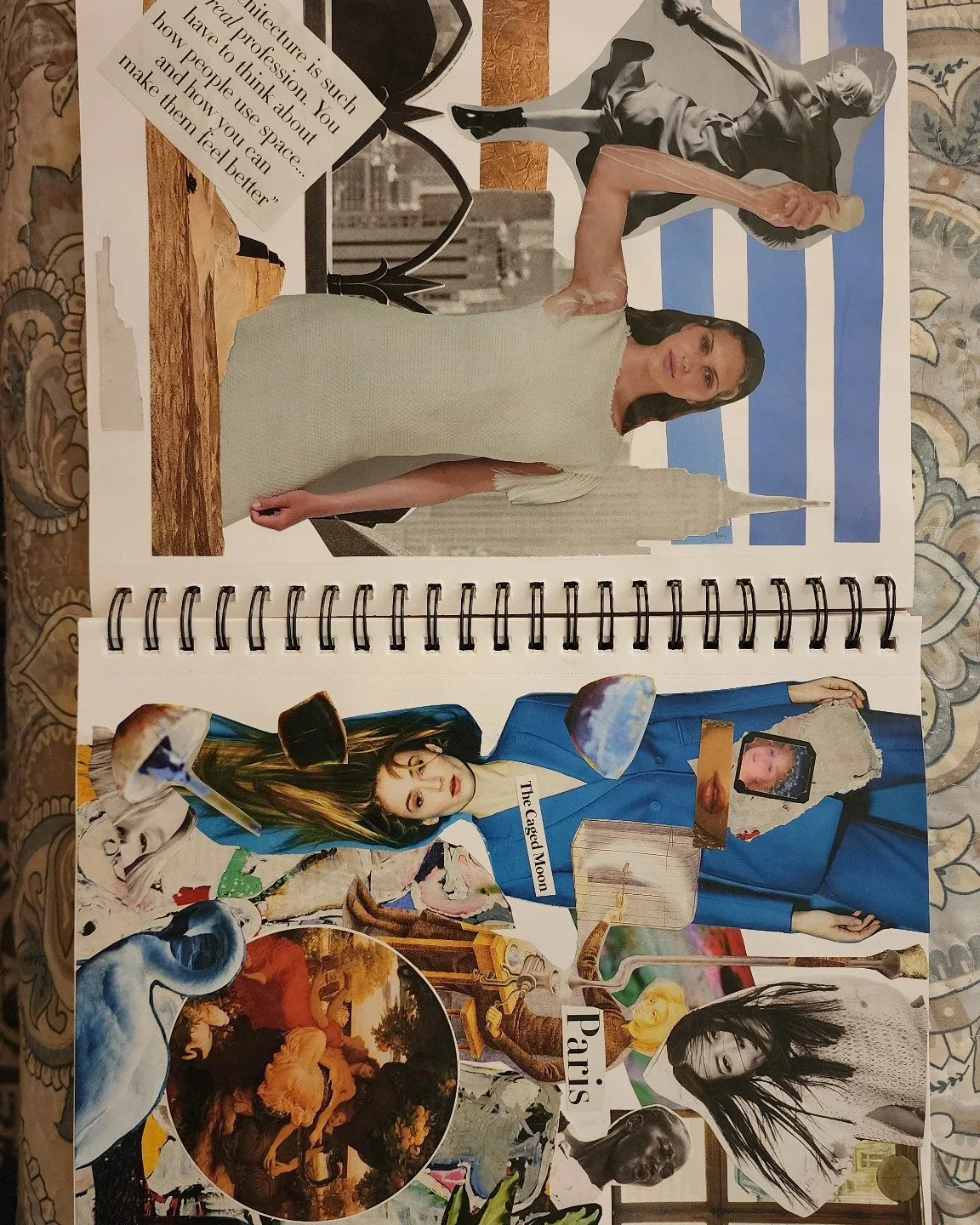
Skylines / Paris: A Discourse
R. Allen Smith
Paper collage using cut imagery from popular magazines
2025
Relational context:
These two works are photographed together intentionally. Their placement creates a visual dialogue between Skylines, positioned above, and Paris: A Discourse, positioned below. The photograph is not simply a record of two separate collages; it becomes a third interpretive space where the works speak to one another across the spiral binding.
In Skylines, architecture, professionalism, and vertical city forms suggest ambition, social mobility, and the disciplined promise of upward movement. The composition feels structured, aspirational, and public-facing. It considers how built environments shape the self, teaching bodies how to appear, perform, and move through spaces of legitimacy.
Below it, Paris: A Discourse becomes denser, more fragmented, and more saturated with cultural signs. Fashion, art history, masks, birds, bodies, and the phrase “The Caged Moon” turn Paris into more than a location. Paris becomes a discourse: a system of images, myths, desires, and expectations through which beauty, sophistication, femininity, and belonging are produced.
The spiral binding between the two works functions as both separation and hinge. It divides the compositions while also holding them in relation. Above, space appears ordered, architectural, and aspirational. Below, space becomes crowded, symbolic, seductive, and unstable. Together, the works suggest that cities are never neutral. They are built materially through architecture and socially through fantasy, language, class performance, memory, and desire.
Interpretive statement:
Photographed together, Skylines and Paris: A Discourse examine space as both built environment and symbolic system. Skylines considers the city as a structure of aspiration, professionalism, and discipline, while Paris: A Discourse presents the city as a layered cultural fantasy produced through fashion, art, spectacle, and longing. Their pairing suggests that identity is shaped not only by the spaces people inhabit, but also by the images and stories attached to those spaces. The city is both skyline and myth, structure and performance, promise and enclosure.
Symbols across the pairing:
Skyline = ambition, modernity, upward mobility, and public aspiration
Architecture = structure, order, discipline, and social design
Central figure in Skylines = self-presentation within professional and urban space
Vertical lines = hierarchy, aspiration, and pressure
Paris text = the city as myth, brand, fantasy, and discourse
“The Caged Moon” = beauty, longing, containment, and unreachable desire
Bird imagery = movement, fragility, freedom, and constraint
Masks and fragmented faces = identity as constructed, performed, and partially hidden
Spiral binding = hinge, division, connection, and the material presence of the sketchbook
Layering = memory, excess, cultural accumulation, and unstable meaning
Theoretical note:
This pairing draws on Henri Lefebvre’s understanding of space as socially produced (Lefebvre, 1991). The city is not treated as a neutral backdrop, but as something that organizes bodies, behaviors, ambitions, and desires. Skylines emphasizes the disciplinary and aspirational force of built space, while Paris: A Discourse emphasizes the symbolic production of place through fashion, art history, spectacle, and cultural fantasy.
Together, the works also echo Michel Foucault’s concern with how subjects are shaped through systems of visibility, classification, discourse, and normalized behavior (Foucault, 1972, 1995). Here, “discourse” refers not only to language, but to the systems of images, classifications, and cultural expectations through which Paris becomes recognizable as an idea. The photograph itself extends the argument: meaning is produced not only inside each collage, but also through their placement, relation, and encounter.
References
Foucault, M. (1972). The archaeology of knowledge and the discourse on language (A. M. Sheridan Smith, Trans.). Pantheon Books.
Foucault, M. (1995). Discipline and punish: The birth of the prison (A. Sheridan, Trans.). Vintage Books. Original work published 1975.
Lefebvre, H. (1991). The production of space (D. Nicholson-Smith, Trans.). Blackwell. Original work published 1974.